Bandhani: The Timeless Art of Tied & Dyed Textiles
Introduction: Overview and Cultural Significance
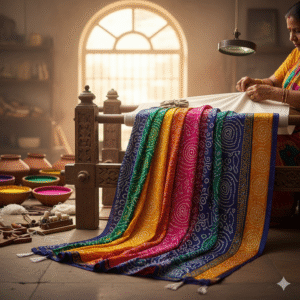
Bandhani, derived from the Sanskrit word bandh (“to tie”), is a traditional Indian resist-dyeing technique. Tiny knots are tied on the fabric before dyeing, preventing color from penetrating those areas and creating mesmerizing patterns of dots, circles, squares, and waves.
Cultural Significance:
Tied to auspicious occasions like festivals (e.g., Navratri, Teej) and weddings, where it’s a bride’s trousseau symbolizing fertility, prosperity, and marital bliss.
Vibrant hues — red for joy, yellow for new beginnings — reflect Indian festivity and spiritual depth.
More than fabric, Bandhani embodies cultural continuity, worn in turbans (safa) by Sindhi/Rajasthani men to signify status and celebration.
History and Origin
The art of Bandhani dates back over 4,000 years, with early dyeing techniques evident in the Indus Valley Civilization (~4000–2500 BCE), including resist-dyed fabrics from Mohenjo-daro.
The first written reference appears in the 7th-century Harshacharita by Bana Bhatt, describing a royal bride in a Bandhani saree for good fortune.
The Khatri community of Gujarat pioneered the craft, which flourished under Mughal patronage with opulent designs. Over centuries, regions adapted unique styles — Gujarat for fine dots, Rajasthan for bold motifs — preserving traditions while evolving.
Today, Gujarat and Rajasthan remain hubs, with GI tags (e.g., Jamnagar Bandhani since 2008) safeguarding authenticity.
Origin City/Region
Key centers of Bandhani production:
Gujarat: Jamnagar (“Bandhani City” for tight knots), Bhuj, Mandvi, Anjar, and Kutch — known for silk sarees and natural dyes.
Rajasthan: Jaipur, Udaipur, Sikar, Jodhpur — famous for vibrant, geometric patterns on cotton/georgette.
These areas, home to ~20,000–30,000 artisans (mostly women from the Khatri community), blend heritage with modern demands, exporting globally while empowering rural economies.
Historical variants extend to Sindh (Pakistan) and Tamil Nadu (Sungudi), highlighting Bandhani’s cross-cultural roots.
Traditional Making Process
Bandhani creation is labor-intensive, demanding precision and patience — often taking days for a single saree.
Step-by-Step Process:
1. Fabric Preparation:
Fine cotton, silk, georgette, or crepe is washed, bleached, and folded.
2. Pattern Marking:
Designs are outlined using wooden blocks dipped in chalk paste or geru (natural clay).
Iconic motifs include Chandrakala (lunar dots), Leheriya (waves), or Shikari (hunting scenes).
3. Tying (Bandhej):
Fabric is pinched with fingernails and tied into tiny knots with thread — thousands per piece for crisp patterns.
Uniform tension ensures definition.
4. Dyeing:
Sequential immersion in dyes, starting lightest (e.g., yellow) to darkest (e.g., red).
Traditionally natural dyes: turmeric (yellow), indigo (blue), pomegranate (red), or lac (crimson); modern synthetics add vibrancy.
5. Opening the Ties:
Knots are gently untied, revealing patterns with subtle puckering for texture.
Key Notes:
Resist-dyeing creates unique, handmade designs — no two pieces identical.
Eco-friendly: Natural dyes and minimal waste align with sustainable fashion.
Global Appeal and Recognition
Bandhani’s handmade charm and cultural depth have earned it worldwide acclaim, blending tradition with versatility.
Why It Appeals Globally:
Uniqueness: Each knot reflects artisanal skill, offering one-of-a-kind art.
Versatility: From sarees/lehengas to scarves, kurtas, and home décor — pairs with ethnic or fusion wear.
Ethical Appeal: Supports artisans and sustainability, drawing eco-conscious buyers.
Export Value: Valued at ~₹2,000–5,000 crore in India’s textile exports (FY 2023–24), shipped to USA, UK, Canada, UAE, Australia, and Europe via e-commerce (Etsy, Amazon India) and designer lines (e.g., Sabyasachi fusions).
Challenges:
Machine-printed imitations threaten authenticity, but GI tags and cooperatives ensure preservation.
In 2025, India’s FTAs (e.g., India-UK) boost exports, promoting Bandhani in global fashion weeks.
Brand Spotlight: Bandhej
Bandhej, a pioneering Ahmedabad-based brand, preserves Bandhani while innovating for modern tastes.
Overview:
Specializes in sarees, dupattas, lehengas, and custom fabrics, using ethical sourcing and handcrafted techniques.
Founded: 1985 (first store in Ahmedabad)
Founder: Archana Shah (NID alumna, focused on reviving crafts)
Headquarters: Ahmedabad, Gujarat
Estimated Turnover: ₹50–100 crore (per industry reports)
Market Presence: Exports to USA, UK, Canada, Australia, UAE; collaborates with global retailers, empowering 200+ artisans.
Bandhej exemplifies sustainable luxury, blending Bandhani with contemporary silhouettes for “Made in India” elegance.
Conclusion: Proudly Made in India
Bandhani is more than fabric — it’s a narrative of history, culture, and resilience.
From Indus Valley origins to GI-protected hubs, each knot honors generations of artisans crafting joy and prosperity.
Ancient Roots: Over 4,000 years of dyeing innovation.
Global Reach: Adored in fashion markets, fueling exports and empowerment.
Timeless Blend: Tradition meets modernity in sustainable style.
As ethical fashion rises, Bandhani shines as a “Proudly Made in India” treasure — vibrant, enduring, and woven with heritage.




Post Comment