Central Travancore Jaggery – Pure Traditional Sweetness from India
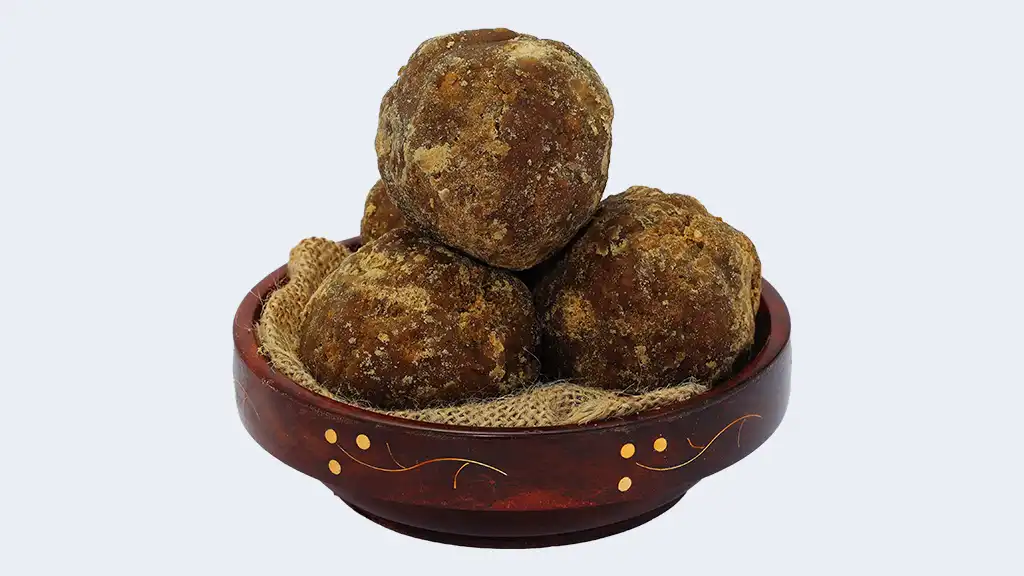
Central Travancore Jaggery (locally known as Thekkadi Sharkkara) is a traditional unrefined sugar made from sugarcane grown in Kerala’s lush central belt — notably Kottayam, Pathanamthitta, and Alappuzha districts. Recognized for its deep golden color, rich caramel aroma, and naturally balanced sweetness, this jaggery represents the essence of Kerala’s agrarian tradition.
Once an essential cottage industry, Central Travancore Jaggery today stands as a symbol of purity and authenticity, with rising demand in domestic and international natural food markets.
History and Origin
The roots of jaggery-making in Central Travancore trace back centuries, when small farmers processed sugarcane juice manually during the post-harvest season. The fertile alluvial soil and abundant rivers like Pamba and Meenachil made the region ideal for cane cultivation.
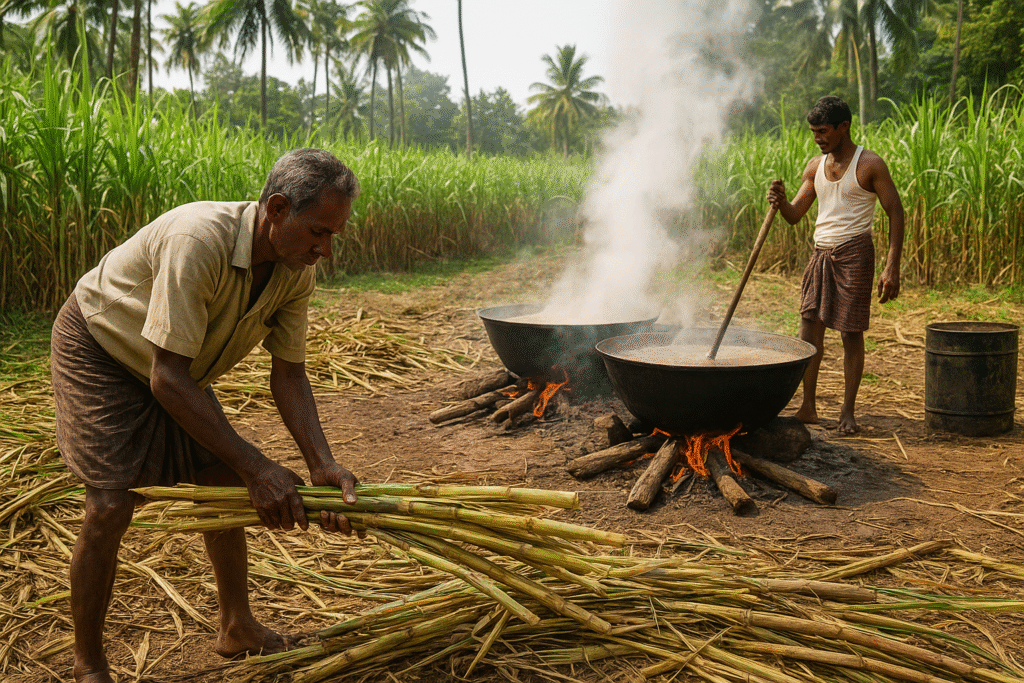
Local sharkkara urals (jaggery units) emerged as community enterprises where farmers boiled freshly crushed cane juice in brass vessels over firewood to create natural sweet blocks. This handmade process, preserved through generations, continues to define the jaggery’s unique identity.
The product plays a key role in Kerala’s rituals, temple offerings, and festive cuisine, including iconic sweets like Ada Pradhaman, Sharkkara Varatti, and Aravana Payasam.
Manufacturing Process
1. Harvesting
Fully matured sugarcane is hand-cut at peak ripeness to ensure high sugar content.
2. Juice Extraction
The harvested cane is crushed using traditional wooden or mechanical crushers (ural) to extract fresh juice.
3. Clarification
Impurities in the juice are removed using natural agents such as bhindi (okra) extract, which helps in purification.
4. Boiling & Concentration
The filtered juice is slowly boiled in large brass or cast-iron pans over firewood until it thickens and concentrates into syrup.
5. Molding & Cooling
The thick syrup is poured into molds (achus) and allowed to cool, forming solid jaggery blocks.
6. Drying & Storage
The jaggery blocks are sun-dried and then stored in cool, dry spaces to maintain quality and shelf life.
Manufacture and Export – Central Travancore Jaggery
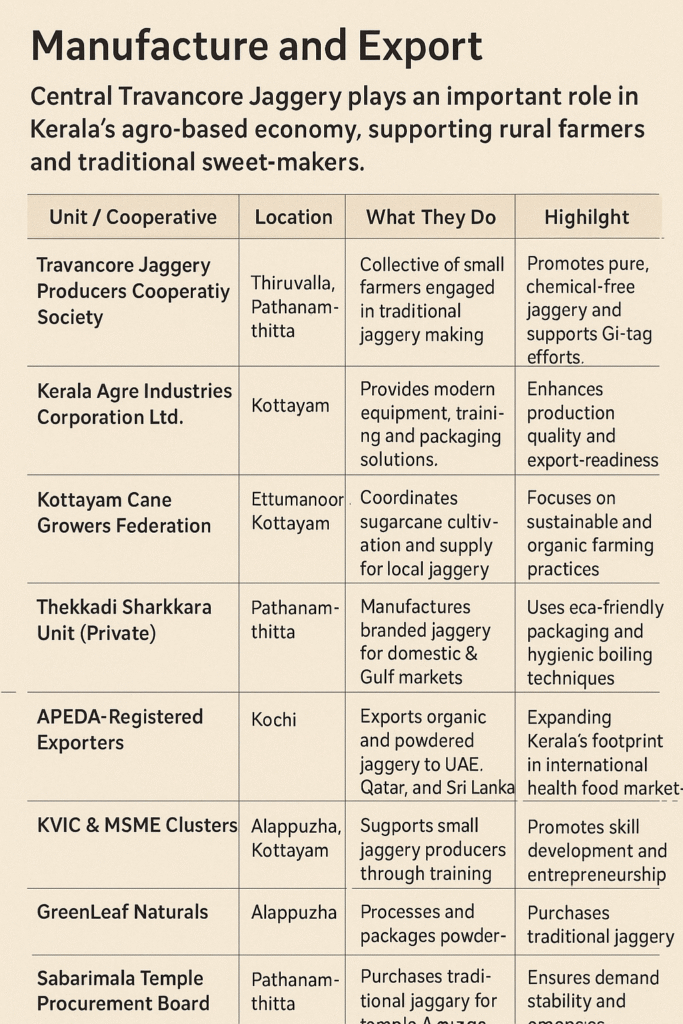
Central Travancore Jaggery plays an important role in Kerala’s agro-based economy, supporting rural farmers and traditional sweet-makers.
Key Units / Cooperatives
1. Travancore Jaggery Producers Cooperative Society
Location: Thiruvalla, Pathanamthitta
What They Do: Collective of small farmers engaged in traditional jaggery making
Highlight: Promotes pure, chemical-free jaggery and supports GI-tag efforts
2. Kerala Agro Industries Corporation Ltd.
Location: Kottayam
What They Do: Provides modern equipment, training, and packaging solutions
Highlight: Enhances production quality and export-readiness
3. Kottayam Cane Growers Federation
Location: Ettumanoor, Kottayam
What They Do: Coordinates sugarcane cultivation and supply for local jaggery units
Highlight: Focuses on sustainable and organic farming practices
4. Thekkadi Sharkkara Unit (Private)
Location: Pathanamthitta
What They Do: Manufactures branded jaggery for domestic and Gulf markets
Highlight: Uses eco-friendly packaging and hygienic boiling techniques
5. APEDA-Registered Exporters
Location: Kochi
What They Do: Export organic and powdered jaggery to UAE, Qatar, and Sri Lanka
Highlight: Expands Kerala’s footprint in the international health-food market
6. KVIC & MSME Clusters
Location: Alappuzha, Kottayam
What They Do: Support small jaggery producers through training and financial schemes
Highlight: Promote skill development and rural entrepreneurship
7. GreenLeaf Naturals
Location: Alappuzha
What They Do: Processes and packages powdered jaggery
Highlight: Purchases traditional jaggery from local producers
8. Sabarimala Temple Procurement Board
Location: Pathanamthitta
What They Do: Purchases traditional jaggery for temple use
Highlight: Ensures steady demand and supports local producers
Cultural and Economic Importance
For Central Travancore’s farming communities, jaggery is both an economic resource and a cultural emblem. It supports hundreds of small-scale producers, creates seasonal employment, and preserves Kerala’s traditional food craftsmanship.
Culturally, it symbolizes purity, prosperity, and wellness, used in rituals, Ayurvedic tonics, and festive cooking. Its natural, mineral-rich profile also aligns with modern health trends, increasing its appeal in urban and global markets.
Economically, jaggery production strengthens Kerala’s rural value chains, enabling small farmers to diversify income while promoting eco-friendly and sustainable agriculture.
Recognition and Global Reach
With the government’s push to register Central Travancore Jaggery under GI protection, the product is poised to gain official recognition for its origin and method.
Organizations such as APEDA, KVIC, and the Department of Agriculture (Kerala) are actively supporting this initiative through certification drives and export promotion campaigns.
Global demand for natural sweeteners and chemical-free products has made Central Travancore Jaggery increasingly popular in the Gulf and Southeast Asian markets, where it is exported under organic and wellness food labels.
Conclusion
From the green fields of Kerala’s heartland to the kitchens of the world, Central Travancore Jaggery stands as a golden emblem of tradition, purity, and sustainability.
Handcrafted with care, its sweetness tells the story of hardworking farmers, ancient wisdom, and Kerala’s deep-rooted respect for nature. As global consumers return to natural foods, this humble jaggery continues to uphold the timeless legacy of “pure sweetness, pure Kerala.”