Tata Salt vs Aashirvaad Salt: An Honest Answer for Indian Kitchens
My mother has used Tata Salt since before I was born. Transparent orange packet, same shelf, every single month. So when I started seeing Aashirvaad Salt pop up at our local kirana and supermarkets with almost the same price tag, I decided to actually test both not just read about them.
This isn’t a brand profile. It’s a real-use comparison for anyone trying to decide between these two at the store.
What's Inside Tata Salt and Aashirvaad Salt Packets
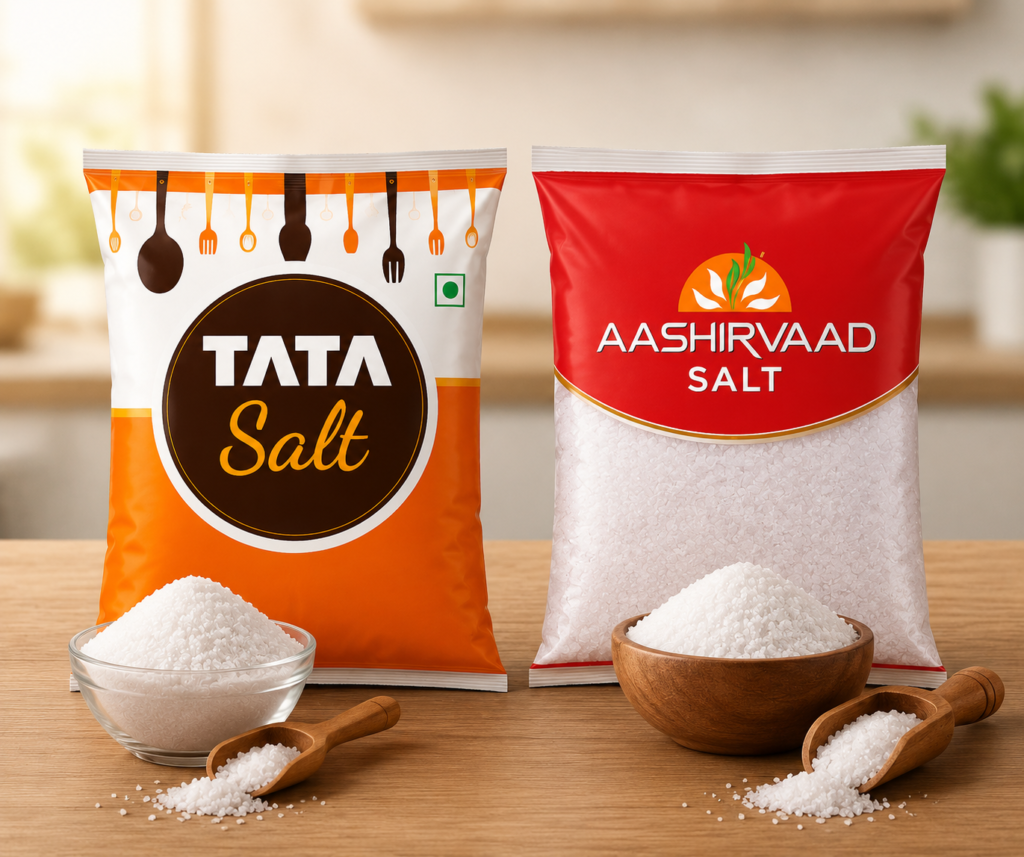
Salt is salt- sodium chloride. But the difference between a branded pack and loose salt from a gunny bag isn’t just marketing. Both Tata Salt and Aashirvaad Salt are vacuum-evaporated iodised salts, which means the iodine is stable, the granules are uniform, and the contamination risk is low.
Tata Salt has been doing this since 1983. At the time, most Indian families bought loose salt, and iodine levels were completely inconsistent. Tata essentially created the category for packaged salt in India and spent decades educating consumers & society about why iodine matters for thyroid health and child development.
Aashirvaad came into salt much later, the brand itself launched in 2002, and it first built its reputation on atta before expanding into salt and spices. Its entry into salt was backed by ITC’s distribution muscle and the trust Aashirvaad atta had already earned in Indian kitchens.
So what’s different inside? Aashirvaad markets a “4-step purification” process and emphasises anti-caking agents that keep the salt free-flowing in humid conditions, useful in coastal states and during the monsoon. Tata Salt’s vacuum evaporation process is well-established and has the advantage of decades of consistency. In terms of actual nutrition and safety, both meet FSSAI standards.
Taste: Is There Actually a Difference?
Honestly? Very little. Anyone telling you they can reliably identify the brand in a blind test is probably imagining it.
Both salts are fine-grained and dissolve quickly. The saltiness level is standard. What changes is texture experience in certain uses, Aashirvaad feels marginally more free-flowing, which some people notice when using a salt shaker in humid weather. Tata Salt can clump slightly faster in the same conditions, though this varies by storage.
For cooking dal, sabzi, roti dough, chutneys there’s no practical difference. Both brands work identically.
Price Comparison: What Does Aashirvaad Salt 1kg Actually Cost?
| Pack Size | Tata Salt | Aashirvaad Salt |
|---|---|---|
| 1 kg | ₹28–₹32 | ₹28–₹35 |
| 2 kg | ₹55–₹62 | ₹55–₹65 |
| 5 kg | ₹130–₹145 | ₹135–₹150 |
Tata Salt vs Aashirvaad Salt- Which Should You Buy
- Buy Tata Salt if: You’ve used it for years and see no reason to switch. The brand has earned its place in Indian homes through consistency over four decades. It’s also more reliably available in smaller cities and rural areas. If your family already trusts it, there’s no compelling reason to change.
- Buy Aashirvaad Salt if: You’re an Aashirvaad household already you use their atta, their spices, their ghee. The brand has clearly invested in building a complete kitchen ecosystem, and salt fits naturally into that. Their processing claims are credible, and ITC’s quality infrastructure is serious.
- The real answer: Both are good. This is one category where brand loyalty matters more than objective quality differences, because the quality gap is genuinely tiny.
What About Other Salt Options?
Since some visitors arrive here comparing salt options more broadly, here are the main types of salt sold in India and where these brands fit:
Regular iodized table salt (Tata, Aashirvaad, Captain Cook) is what most Indian households use and what this article covers. Rock salt (sendha namak) is used in fasting foods and Ayurvedic cooking, neither Tata nor Aashirvaad focuses here. Pink Himalayan salt has become fashionable in urban markets but is expensive and offers no proven health benefit over standard iodized salt. Low-sodium salt (like Tata Salt Lite) replaces some sodium with potassium and is recommended for people managing blood pressure. Sea salt and black salt (kala namak) are used for specific Indian recipes and chutneys.
For daily cooking, stick with iodized table salt. It’s what public health recommendations in India are built around.
The Bigger Picture Why Both Brands Matter
India produces over 30 million tonnes of salt annually, third highest in the world with Gujarat alone contributing about 75% of that output. The shift from loose, unbranded salt to packaged iodized salt over the past 40 years is one of the quieter public health wins in Indian FMCG history.
Both Tata and ITC played a real role in that shift. Tata Salt did it first; Aashirvaad did it with the muscle of an already-trusted kitchen brand. That competition has been good for Indian consumers, prices have stayed accessible, quality has remained high, and iodine deficiency disorders have declined.
When you pick either brand off a shelf, you’re buying into something that actually worked.
Final Verdict on Tata Salt vs Aashirvaad Salt
Tata Salt is the default choice for a reason it’s been consistent for over 40 years, it’s available everywhere, and the Tata name carries genuine weight. Aashirvaad Salt is a strong, credible alternative, especially if you’re already an ITC household.
Neither will make your food taste better or worse than the other. Choose on availability, price, and habit. Both are proudly Indian, both are safe, and both do the job well. We also have an article on Jaggery vs Sugar .
FAQs
What is the price of Aashirvaad Salt 1kg?
Typically ₹28–₹35 at most retailers in India, though prices vary by city and platform. Check BigBasket or Blinkit for current pricing in your area.
Which salt is better for health Tata or Aashirvaad?
Both are iodized and meet FSSAI standards. Health outcome depends on how much salt you use, not which brand you pick.
Is Tata Salt available everywhere in India?
Yes, and it has stronger rural penetration than most competitors. Aashirvaad Salt is catching up but Tata’s distribution in smaller towns is still stronger.
Can I use both salts interchangeably in cooking?
Completely. There’s no recipe where one will work and the other won’t.