The Cloth That Kings Gave Away — And One Woman Refused to Let Die
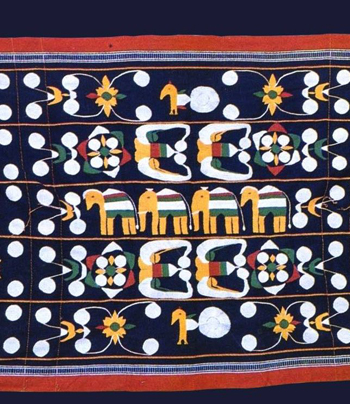
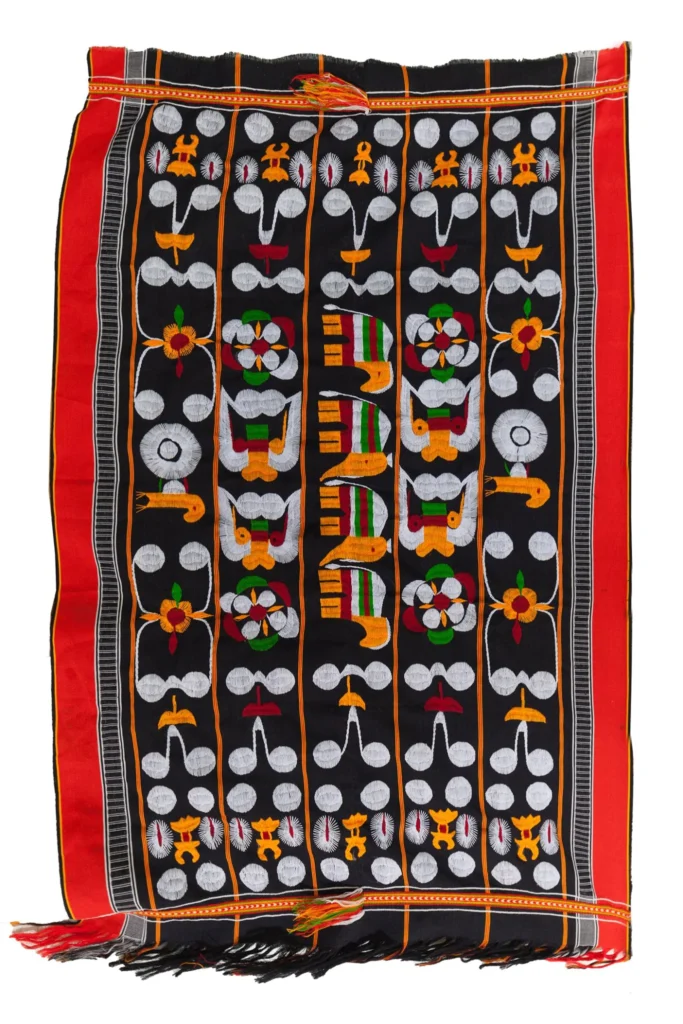
There is a shawl sitting in a museum in Imphal that most Indians have never heard of. It has ten embroidered creatures on it — an elephant, a horse, a peacock, a fish, a spear, a moon, a sun, a star, a buffalo horn, and a magical seat called a phantup. Each motif was stitched by hand, without a frame, using cotton thread on loom-woven fabric. The stitching took weeks. The shawl was not made to be sold. It was made to be given — specifically, to a man who had done something worth remembering.
This is Shaphee Lanphee. And if you’ve never heard of it before, you’re not alone. Despite being one of the few Indian handlooms with a Geographical Indication (GI) tag, despite a history stretching back to a king named Loiyumba who ruled Manipur in the 11th century, and despite the life’s work of at least three generations of women who fought to keep the craft from disappearing entirely — Shaphee Lanphee remains, in most of India, a secret.
What the Name Actually Means
Most writeups skip this. They shouldn’t.
Shaphee literally translates to “the fabric of animals.” Lanphee means “the fabric of war.” Together, the name tells you exactly what this textile was: a cloth meant for warriors, decorated with the symbols of the natural world a soldier carried into battle.
That’s not poetic license. That’s etymology.
The black background wasn’t chosen for aesthetic reasons — it represented authority and the weight of what the shawl stood for. The red border wasn’t decorative — it signalled the king’s recognition. When a Meitei king draped this shawl over someone’s shoulders, he wasn’t giving them a garment. He was publicly declaring: this person acted with courage, and the kingdom remembers.
King Loiyumba and the Khoisnam Clan
The story of Shaphee Lanphee goes back to at least 1074 AD.
According to the manuscript Loiyumba Silyen, King Loiyumba — who ruled Manipur between 1074 and 1122 AD — officially authorised the Khoisnam family to weave Shaphee Lanphee. The legend goes that the king saw a man from the Khoisnam clan wearing this distinctive fabric while riding a horse. Struck by its visual power, Loiyumba adopted it as the official honour cloth of his kingdom — specifically to be presented to the brave Naga chiefs of Manipur as a gesture of royal recognition.
This wasn’t just ceremonial. In the political geography of medieval Manipur, honouring Naga chiefs with a Meitei royal textile was a diplomatic act — a fabric bridge between communities.
The Khoisnam lineage’s connection to this cloth isn’t just historical. Scholars and GI registration documents describe Shaphee Lanphee as “exclusively a product of the Khoisnam lineage.” That’s a level of craft ownership that almost no other Indian textile can claim.
Ten Motifs, Ten Stories
What separates Shaphee Lanphee from most handloom textiles is the specificity of its symbolism. These aren’t generic patterns. Each of the ten motifs has a name, a meaning, and in some cases, a mythological reference:
Shamu (elephant) — Royalty and memory. Elephants in Meitei culture represent the king’s power and endurance.
Shagol (horse) — Movement and military strength. A warrior’s companion.
Iroichi (buffalo horn) — Ferocity and sacrifice. Buffalo were used in traditional rituals.
Nga (fish) — Connected to the myth of King Naothingkhong (663–763 AD), who figures in the origin stories of Meitei water symbolism.
Numit (sun) — The celestial father, symbolizing supreme power.
Tha (moon) — The celestial mother — together with the sun, representing the cosmos watching over the king’s authority.
Thawanmichak (star) — Guidance and fate.
Phantup (magical seat) — The king’s throne. Sovereignty made physical.
Ta (spear) — The weapon. War remembered.
Wahong (peacock) — Beauty, pride, and the idea that bravery deserves to be seen.
Taken together, these ten motifs aren’t decorations. They’re a cosmology — a compressed portrait of the Meitei universe, stitched into a single cloth.
The Century It Almost Disappeared
By the mid-20th century, Shaphee Lanphee was dying.
The royal courts that had ordered it were gone. The ceremonial context that gave it meaning had eroded. Younger weavers were moving toward textiles that sold faster, earned more, and required less time. The intricate needlework of Shaphee Lanphee — done entirely by hand, without a frame, motif by motif — could take weeks for a single piece. In a market that wasn’t paying for that kind of patience, the craft became economically unviable.
It survived because of one family.
The Woman Who Kept It Alive
Her name is Maisnam Lalini Devi, and she learned to weave Shaphee Lanphee from her mother.
Lalini grew up in Wangkhei Yonglan Leirak, a small village in Manipur. Her mother had kept the craft going through sheer refusal to let it go. Lalini and her younger sister Maisnam Anita continued the tradition — in 1992, Anita won a state award for her Shaphee Lanphee work.
Then Anita died.
Lalini was left as the sole practitioner of a craft that, without her, would likely have ceased to exist in living practice. She continued anyway. She trained local women. She exhibited at craft bazaars. She entered competitions — winning third place at the Eco Craft Bazaar in 2007, second place at the state-level handloom competition that same year. She donated pieces to collections. She kept showing up.
In 2009, she received the state award for Mastercraftsperson. In 2011, the Panthoibi Cultural Research Centre for Performing Arts honoured her with the Nongpok Panthoibi Award for her work in promoting Shaphee Lanphee. In 2019, the Ministry of Textiles selected her for a national award in the endangered craft category.
A single embroiderer can earn around ₹300 for completing a Shaphee Lanphee piece. Lalini has used this work — supplemented by training other women and building a small handloom enterprise — to contribute toward her daughter’s MBBS education.
That’s the actual economics of keeping a 1,000-year-old craft alive in 21st-century India.
The GI Tag and What It Means
Shaphee Lanphee received its Geographical Indication (GI) registration on December 19, 2011 — the same year Lalini received the Panthoibi Award, as if the universe had decided to mark the moment twice.
The GI tag means that only Shaphee Lanphee produced in Manipur can legally be called Shaphee Lanphee. It’s in the same protected category as Darjeeling tea or Mysore silk — a formal recognition that the craft is tied to a specific place, a specific community, and a specific tradition that cannot simply be replicated elsewhere and sold under the same name.
The Consultative Committee that oversees the GI registration includes representatives from Manipur University, the Weavers Service Centre, the Primary Weavers Service Cooperative Society, the Indian Institute of Entrepreneurship, and Mutua Museum in Imphal. It’s a serious institutional apparatus — which makes the textile’s continued obscurity outside Manipur even more striking.
How It's Actually Made
Here’s what most articles don’t tell you: Shaphee Lanphee is two crafts in one.
First, a base fabric is woven on a loin loom — the traditional body-tension loom used by Meitei women, where the weaver literally uses her own body weight to maintain warp tension. This alone requires skill and practice.
Then, on top of this woven base, the ten motifs are embroidered by hand using needle and cotton thread (sometimes silk) — without a frame. No hoop, no stand, no grid. The embroiderer works entirely by hand, from memory and training, building up each motif stitch by stitch.
The base fabric is typically black cotton with a red border. The embroidery work is done in red, white, and occasionally other traditional colours. The finished piece is usually worn as a shawl — draped over the shoulders in the manner of its original purpose as an honour cloth.
Today, the stylized motifs have also been adapted onto waistcoats, and the fabric is exported in various garment forms. But the traditional shawl remains the authentic form.
Why Your Search Found This Page
If you searched “shaphee lanphee” and landed here, you’re probably curious about one of three things: what it looks like, where to buy it, or what its cultural significance is.
On the first: photographs of Shaphee Lanphee show a dark, dramatic textile — the black base gives it an authority that brighter fabrics don’t have. The embroidered motifs stand out sharply in red and white against the dark background, making each creature identifiable even from a distance. It looks, to modern eyes, like something that belongs in a heritage collection or on a statement garment — not as a souvenir.
On buying it: authentic Shaphee Lanphee is available through Manipur state handloom cooperatives, select heritage textile boutiques, and government craft exhibitions. Because it is handmade with intensive labour, expect prices that reflect that. A piece sold for ₹200–300 in weaver’s wages took weeks to make. The retail price should tell you something about how undervalued the craft remains.
On cultural significance: you’ve now read the story. The short version is this — Shaphee Lanphee is not decorative. It was never meant to be. It’s a textile that encodes a society’s values — bravery, royalty, the natural world, the cosmos — into cloth that could be worn. That it survived the decline of the courts that commissioned it, the economic pressures that killed most comparable crafts, and the indifference of the mainstream market is because of specific people who refused to let it go.
What Needs to Happen Next
Shaphee Lanphee has the ingredients: history, GI protection, aesthetic power, a compelling human story, and increasing interest from the heritage textile market globally.
What it lacks is visibility.
The craft is currently produced in small quantities by a limited number of artisan families. Training programmes exist but are under-resourced. The market pays embroiderers ₹300 per piece for weeks of work — a rate that makes the craft economically difficult to sustain as a primary livelihood.
There are things buyers can do: purchase directly from cooperative sources where artisans receive a fairer share. Share the craft’s story, not just its image. Recognise that when you buy a piece of Shaphee Lanphee, you’re not acquiring a product — you’re participating in a 1,000-year-old tradition that is still, even now, in the process of being saved.